
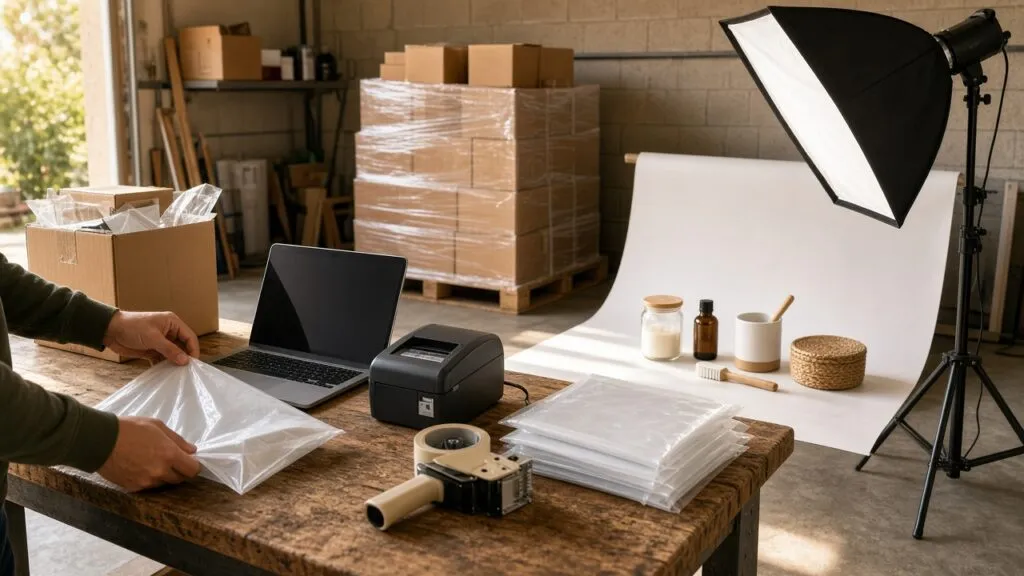
To start a reselling business with liquidation pallets, pick one sales channel and one or two product categories, register the business and sales-tax side properly, buy a small first lot, then build a repeatable sort–list–ship routine before you scale. This guide sets that out step by step for 2026, with the practical decisions that tend to make or break a new pallet-flipping business: cash, space, channels, compliance and buying discipline.
Step 1: Decide how you’ll sell before you buy anything
Your sales channel decides which pallets make sense, how much space you need and how you spend your time. The main options:
- Online marketplaces – eBay, Facebook Marketplace, Mercari, Poshmark and Depop for apparel, and others. Low startup cost, wide reach, but you handle photos, listings, customer messages and shipping.
- Live selling – Whatnot, TikTok Shop and similar platforms. Fast sell-through when you build an audience, but you need reliable stock and on-camera time.
- Bin store – a physical store where prices drop through the week. Moves huge volumes of mixed goods, but needs a lease, fixtures, staff and steady truckload supply.
- Flea markets, swap meets and pop-ups – a low-commitment way to test demand and clear slower stock.
- Selling to other resellers – breaking larger loads into smaller lots for others, once you understand pricing.
Most successful pallet resellers combine two channels: one for their best items (usually online) and one to clear volume (bins, markets or bulk lots).
Step 2: Choose your first categories
Start with categories you can judge quickly. If you know clothing sizes and labels, start with clothing pallets (see our guide to clothing pallets). If you can test and repair power tools, tool pallets may suit you. For a bit of everything, general merchandise pallets give variety but need more sorting. A side-by-side comparison of clothing, shoes and home goods is in best pallets to resell for profit.
Questions to ask about any category:
- Can I tell a good item from a bad one in under a minute?
- Do I know where sold prices for these items can be checked?
- Is it bulky or heavy to store and ship?
- Are there safety or platform restrictions, such as children’s products, cosmetics, batteries or branded goods?
Step 3: Set up the business side
Rules vary by state, county and city, so confirm locally. The usual building blocks in the U.S. are:
- Business structure. Many resellers start as a sole proprietorship, and some form an LLC for liability separation. A tax professional can help you choose.
- EIN. An Employer Identification Number is free from the IRS at irs.gov and is useful for banking and supplier accounts.
- Sales tax permit and resale certificate. Most states that charge sales tax require you to register if you sell taxable goods. A resale certificate can let you buy inventory for resale without paying sales tax at purchase. Each state’s revenue department publishes its requirements.
- Local business license where required, especially for a physical store or market stall.
- A separate business bank account and simple bookkeeping from day one. Track every pallet’s cost, freight and sales so you know which loads actually make money.
Note that many marketplaces collect and remit sales tax on your behalf for online sales, but in-person sales and your own website are usually your responsibility.
Step 4: Plan your space and tools
One pallet can fill a single-car garage once it’s unpacked. Before your first delivery, plan:
- Receiving: can a freight truck reach you? Commercial addresses with a dock are simplest; residential deliveries may need liftgate service. Picking up yourself with a suitable trailer or box truck is another option.
- Handling: a pallet jack or enough help to break the pallet down safely.
- Sorting area: tables, bins and labels for “list”, “bulk”, “fix or clean” and “dispose”.
- Listing station: a plain backdrop, good light, a phone or camera, a scale and a tape measure.
- Shipping station: boxes, mailers, tape and a label printer.
- Storage: shelving with numbered bin locations so you can find items when they sell.
Step 5: Set a budget and buying rules
Treat your first purchase as tuition. Decide in advance how much you can afford to tie up for two to three months, and keep a reserve for freight, supplies, platform fees and a second buy. A few rules that help:
- Start small. One pallet or a smaller lot, such as a mystery box, teaches you more than an early truckload.
- Use landed cost. Pallet price plus freight plus any tax or pickup costs is your real cost. A full walkthrough is in how much a liquidation pallet costs.
- Be conservative on sell-through. Plan for a portion of any returns load to be unsellable.
- Price from sold listings. Original retail value is not your sale price.
- Reinvest deliberately. Buy your next load based on what actually sold from the last one.
Illustrative example only: say your first pallet costs $500 plus $150 freight, for $650 landed. You list the best 40 items online at an average net of $20 after fees and shipping ($800), and sell 60 smaller items at a market for an average of $5 ($300). That’s $1,100 in revenue against $650 in cost, or $450 before your time. If it took you 30 hours, you earned $15 an hour. Tracking that per-hour figure tells you whether to change categories, channels or your workflow.
Step 6: Vet your supplier
Before you pay any liquidation seller, check:
- A real physical business address and phone number, and that someone answers.
- Clear written shipping, return and damage-claim policies.
- Listings that describe condition honestly (returns, untested, as-is) and don’t promise specific items in an unmanifested load.
- An invoice or order confirmation for every purchase, and payment terms you understand.
Liquidation Pallet Co is based in Miami, Florida, at 11440 NW 122nd St Ste 700, Miami, FL 33178, and can be reached at (305) 792-8432 or sales@liquidationpalletco.com. Our lots are sold as-is, all sales are final, and freight damage, shortages or a wrong lot must be reported within 48 hours of delivery with photos. Contiguous U.S. orders ship with a flat $150 freight charge per order (Alaska, Hawaii and U.S. military addresses by quote), and you can collect for free by appointment from our Miami location. Credit and debit cards are accepted on all orders, along with the other payment options shown at checkout. Read our shipping policy, refund and return policy and FAQ before ordering.
Step 7: Build a sort–list–ship routine
- Receive: count pallets, inspect the wrap, note any damage on the delivery receipt and photograph everything.
- Sort within a day or two into your four piles.
- Test and clean what needs it. Check recalls at cpsc.gov/Recalls for children’s items, electronics and anything with a battery.
- List in batches: photos, measurements, honest condition notes, and pricing from sold comparisons.
- Ship fast: quick handling time protects your ratings.
- Clear the tail: after a set period, move unsold items to bulk, bins, markets or donation instead of letting them occupy space.
- Review: after each load, record revenue, time spent and sell-through by category.
Step 8: Scale when the numbers say so
Once you’ve run several loads and know your sell-through and hourly return, scaling options include buying more pallets of the categories that worked, adding a second channel, hiring help for sorting or listing, or moving to truckloads for a lower cost per unit. Truckloads also bring bigger commitments: dock access or a forklift, warehouse space and larger cash outlay.
Common mistakes to avoid
- Buying based on the manifest’s retail value instead of realistic resale prices.
- Ignoring freight and disposal costs.
- Letting inventory pile up unsorted.
- Using brand names in your own listings without verifying authenticity.
- Scaling to truckloads before you have the space, cash and channel to process them.
New to liquidation? Start with what is a liquidation pallet? and customer returns vs shelf pulls vs overstock, then browse our current pallets.
Frequently asked questions
How much money do I need to start reselling liquidation pallets?
Enough to buy one pallet, pay freight, cover supplies and fees, and still have a reserve for a second purchase. Single pallets are often priced in the hundreds of dollars, while truckloads run into the thousands or tens of thousands, so many resellers start with one pallet or a smaller lot.
Do I need a license to resell liquidation pallets?
In most U.S. states you need a sales tax permit if you regularly sell taxable goods, and some cities or counties require a business license. A resale certificate may let you buy inventory without paying sales tax. Check with your state revenue department and local government.
Where can I sell items from liquidation pallets?
Common channels are eBay, Facebook Marketplace, Mercari, Poshmark, Depop, Whatnot, flea markets, bin stores and your own website. Many resellers sell their best items online and clear the rest in person or in bulk.
Is reselling liquidation pallets still profitable in 2026?
It can be, but profit depends on buying the right categories at the right landed cost, processing quickly and selling through channels that suit the goods. Track revenue, time and sell-through for every load to see what actually works for you.
Should I start with a pallet or a truckload?
Start with a pallet or a smaller lot. Move to truckloads once you have consistent sell-through, enough space and equipment to receive a full trailer, and cash to carry the inventory.
Can I pick up my pallet instead of paying for freight?
Yes. Liquidation Pallet Co offers free pickup by appointment at 11440 NW 122nd St Ste 700, Miami, FL 33178. See our Miami pickup guide for hours, vehicles and inspection. Otherwise, orders to the contiguous United States ship with a flat $150 freight charge per order.