
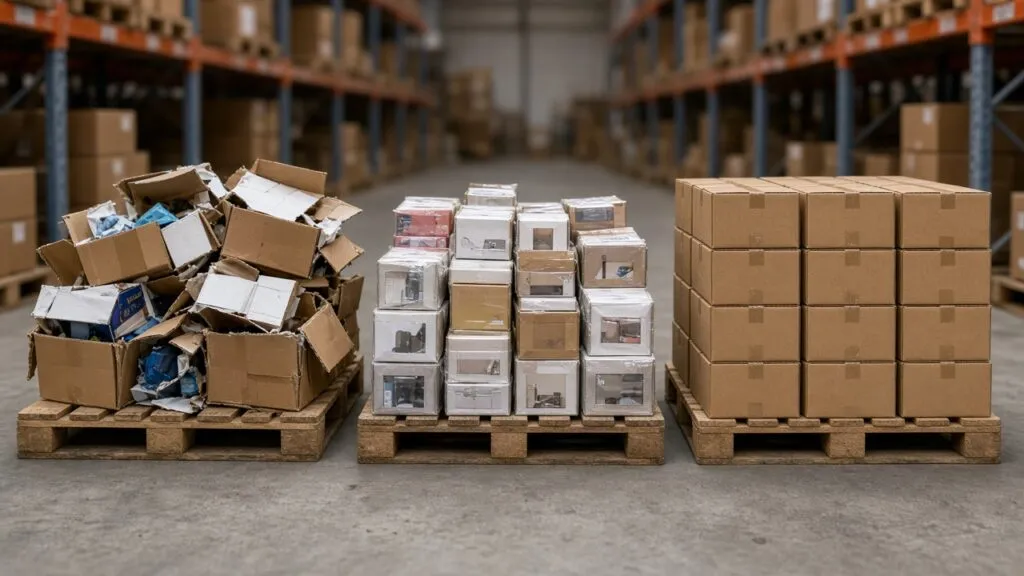
Customer returns are items a shopper bought and sent back, shelf pulls are unsold items taken off a store’s sales floor, and overstock is excess inventory that never reached the shelf. All three are sold as liquidation pallets, but they behave very differently once they land in your store or garage. The labels describe where the goods came from, not a guarantee of their exact condition. Knowing the difference helps you choose loads that fit your sales channel, your labor and your appetite for risk.
The short version
| Stream | Where it comes from | Typical condition issues | Work needed | Often suits |
|---|---|---|---|---|
| Customer returns | Items bought and returned by shoppers | Opened, used, missing parts, faulty, or perfectly fine | Highest: test, clean, complete, grade | Bin stores, high-volume resellers, repair-capable sellers |
| Shelf pulls | Unsold items removed from the sales floor | Price stickers, shelf wear, dented or faded packaging | Medium: tidy packaging, check completeness | Discount stores, curated resale, live sellers |
| Overstock | Excess stock from warehouses or distribution | Repeated quantities, older models or packaging, storage wear | Lowest per unit, but you must move volume | Marketplace sellers, discount retail, exporters |
The rest of this guide explains each stream in more detail and how to decide which one to buy.
Customer returns
Customer returns are the largest and most varied liquidation stream. A shopper may have returned an item because it was the wrong size or color, arrived late, was a duplicate gift, didn’t match the photos, or because it was genuinely defective. Many retailers don’t inspect every return, so they consolidate them by category and sell the pallets “as-is” or “untested”.
What to expect: a range from sealed and new to used, incomplete or broken. Accessories, manuals and chargers may be missing. Some items will be fine to sell straight away, some will need cleaning or a missing part, and some will only be worth parts or recycling.
Why buyers like them: customer return pallets usually offer the lowest cost per item, and the variety keeps bin-store tables interesting.
What it takes: space to sort, a way to test electronics and small appliances safely, cleaning supplies, and a plan for the unsellable portion. Budget time for this; it is real work.
Browse our customer return pallets and online-retailer return pallets, for example this online retailer general merchandise pallet, or go bigger with a raw returns truckload.
Shelf pulls
Shelf pulls are products removed from store shelves without being sold. A retailer might be resetting a department, changing to new packaging, ending a season, or clearing items that have picked up shelf wear. Because nobody bought and returned them, shelf pulls are often new or near-new. Their packaging, though, may show handling: price stickers, scuffs, crushed corners or faded boxes.
What to expect: mostly complete, unused products, some with cosmetic packaging damage. Display units can turn up in the mix.
Why buyers like them: less testing and cleaning than returns, and products that photograph and present well. That makes shelf pulls attractive for discount retail shelves and live selling, where a surprise defect on camera is costly.
What it takes: sticker removal, light repackaging, and still a quick completeness check. A higher price per unit than returns is normal.
Examples on our site include the mass retailer shelf pull truckload and the warehouse club shelf pull truckload.
Overstock
Overstock is inventory that a retailer, distributor or brand has more of than it can sell through normal channels. It may never have reached a shelf at all. Overstock happens through over-ordering, cancelled promotions, discontinued lines, seasonal leftovers and packaging changes.
What to expect: generally new and unused goods, often in case packs, with repeated quantities of the same item. Storage can cause carton wear, and some products may be previous models or carry older packaging.
Why buyers like them: predictable condition and less processing per unit. Multiple units of the same item mean one product listing can sell many times.
What it takes: a channel that can absorb depth, such as marketplace listings, wholesale to other stores, or discount retail. Ten identical items are only an advantage if you can sell ten. Check dates on anything with a shelf life.
See our overstock and new pallets, such as the new overstock general merchandise pallet, or the discount store overstock truckload.
Mixed loads
Many pallets, including several on our site, are described as “mixed-condition returns and overstock”. That simply means more than one stream is present. Treat a mixed load like a returns load for planning: assume some items will need work or be unsellable, and be pleasantly surprised by the clean overstock.
Which one should you buy?
A useful rule: the more closely your customer inspects an item before paying, the more predictable the condition you should buy.
- Bin stores price by the day or by the item and sell huge volumes, so customer returns and high-piece-count loads such as a bin store truckload are a natural fit.
- Online marketplace sellers (eBay, Amazon, Walmart Marketplace and others) benefit from overstock depth and shelf pulls, because condition must match the listing. Note that marketplaces set strict rules for selling used, open-box or returned goods, and some brands and categories are restricted. Check the requirements before you plan a listing strategy.
- Live sellers and boutiques generally do best with shelf pulls and overstock.
- Repair-capable sellers, for example people who can fix small electronics or tools, can find value in untested returns that others pass over.
Questions to ask before buying any pallet
- Which stream is it: returns, shelf pulls, overstock, or mixed?
- Is it manifested? If so, how accurate has the manifest been historically?
- Is it untested, tested or graded? What do the grades mean?
- What is the approximate item count and pallet height?
- What are the shipping cost, delivery requirements and lead time?
- What is the policy if the pallet arrives damaged, short, or isn’t the lot you ordered?
At Liquidation Pallet Co, every lot is sold as-is and all sales are final. Freight damage, shortages or a wrong lot must be reported within 48 hours of delivery with photos. Contiguous U.S. orders ship with a flat $150 freight charge per order, Alaska, Hawaii and U.S. military addresses are quoted, and free pickup by appointment is available at our Miami location. Credit and debit cards are accepted on all orders, with no minimum. After you place your order, an invoice will be sent within a few hours from sales@liquidationpalletco.com; you pay by card from that invoice. Other options shown at checkout remain available. If you’re new to liquidation, start with what is a liquidation pallet?
Safety and compliance reminders
- Check the U.S. Consumer Product Safety Commission recall list (cpsc.gov/Recalls) before reselling children’s products, electronics, appliances and anything with a battery. Selling recalled products is illegal in the U.S.
- Don’t resell expired cosmetics, food or medication, or items with broken seals where safety depends on the seal.
- Test powered items safely and discard swollen or damaged lithium batteries through a proper recycling channel.
Frequently asked questions
If you are specifically looking at online-retailer or “Amazon return” lots, we published a separate guide on what to expect from Amazon return pallets — condition, manifests, testing work and how to read a listing.
What is the difference between customer returns and shelf pulls?
Customer returns were bought by a shopper and sent back, so their condition varies from new to defective. Shelf pulls were never sold; they were removed from the sales floor and are usually new or near-new with possible packaging wear.
Is overstock the same as brand new?
Overstock is usually new and unused, but it is not guaranteed to be perfect. Expect repeated quantities, possible carton wear from storage and sometimes older models or packaging.
Which pallet type is best for beginners?
Many beginners find shelf pulls or overstock easier because they need less testing and cleaning. Customer returns cost less per item but take more sorting, testing and disposal work.
Are customer return pallets tested?
Usually not. Most customer return pallets are sold untested and as-is, so some items may be incomplete or not working. A listing should say clearly if items have been tested or graded.
Can I return a pallet if the condition is worse than expected?
At Liquidation Pallet Co, no; all sales are final and lots are sold as-is. We review freight damage, shortages or a wrong lot when they are reported within 48 hours of delivery with photos.