
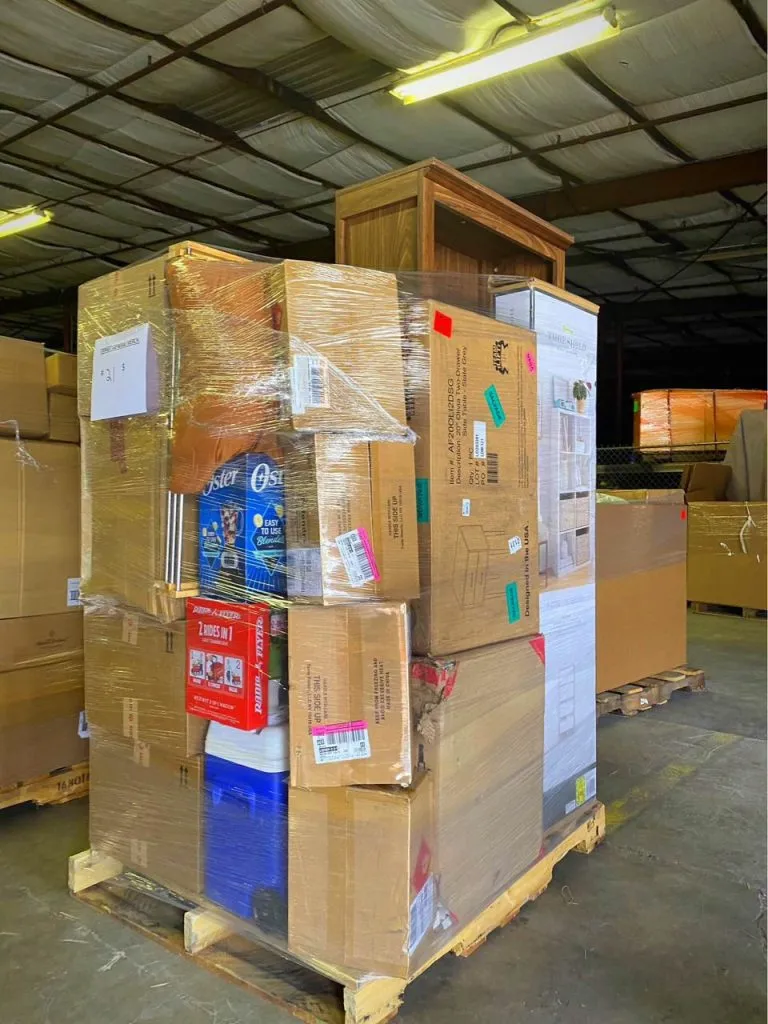
There is no single price for a liquidation pallet. In our November 2026 catalog, most single pallets were listed between about $200 and $1,000, while full truckloads ran from the mid-six-thousands into the tens of thousands of dollars. The number that matters is your landed cost — pallet price plus freight or pickup, plus any tax, plus the time it takes to turn the goods into sales. This guide explains typical ranges in our current inventory and how to run the math before you buy. It goes deeper than the short pricing section in our liquidation pallet buyer’s guide. Inventory and prices change, so treat every figure here as a snapshot, not a quote.
The short answer
As of mid-November 2026 we had about 340 live listings. Looking at those prices:
- Single pallets (not truckloads) mostly sat between $200 and about $1,000, with a midpoint around $500–$600. A smaller number of specialty lots were listed higher.
- Mystery boxes and small lots were typically a few hundred dollars, roughly $200–$700.
- Clothing pallets as singles often landed in the mid-hundreds (recent listings started around $300, with many in the $550–$800 area). Apparel truckloads are a different scale and can be priced in the tens of thousands.
- Shoe pallets as singles were roughly $345–$999. Online-retailer / Amazon-style return pallets often appeared in the $200–$999 range, with many general-merchandise returns around $400–$550. See what to expect from Amazon return pallets.
- Tool pallets were commonly $500–$1,600, with some larger lots higher. Electronics singles were roughly $250–$800.
- Truckloads started around $6,370 for a raw unsorted returns load and went into the mid-$50,000s for large clothing overstock trailers. Many general-merchandise truckloads were listed in the mid-teens to low $20,000s.
Those are asking prices on live listings, not averages of what buyers later earned, and not a promise that the next pallet in that category will be priced the same. Always check the current shop.
What the pallet price actually covers
The listed price is the price of that lot, as described, sitting at our warehouse. It is not a per-item retail price, and it does not by itself include freight (unless you choose free Miami pickup by appointment); sales tax, if your state charges it and you are not buying with a valid resale certificate; your time to collect, sort, test, list and dispose of leftovers; or marketplace fees, packing, outbound shipping and storage. We list a dollar price per lot. Compare that number to your own sell-through estimate, not to the original retail tickets on the boxes.
Why two pallets in the same category can cost very different amounts
Price moves with, among other things:
- Source and condition. Untested customer returns usually cost less, per item, than shelf pulls or cleaner overstock, because they take more work. The differences are explained in returns vs shelf pulls vs overstock.
- Category and item count. A tightly sorted clothing or tool pallet with a usable count is a different product from a mixed mystery load.
- Manifest. Manifested lots often cost more because you can research before you buy.
- Weight, cube and packing style. Tall, heavy or awkward freight is not the same job as a compact pallet of soft goods, even if the sticker prices look similar.
- How fast the lot needs to move. Liquidation inventory turns. A price you saw last week may already have changed.
A cheap pallet is not automatically a good buy. The question is whether the landed cost still works after a conservative sell-through rate in your channel.
Landed cost: the number that matters
Use this simple structure on every lot:
- Pallet price from the listing.
- Inbound freight or pickup. To the contiguous United States we charge a flat $150 per order at checkout. Pickup at our Miami location, 11440 NW 122nd St Ste 700, is free by appointment. If you pick up, add fuel, vehicle rental if you need it, and your time. Alaska, Hawaii and U.S. military addresses are by freight quote. The United Kingdom is by custom freight quote only and is not available at online checkout (Canada ships at the same $150 flat rate per order) — contact us before you order.
- Tax, if it applies to you.
- Realistic sell-through — the share of items you honestly expect to sell, not the best case.
- Average sale price from sold listings in your channel, not original retail and not asking prices.
- Selling costs — fees, packing, outbound shipping, and disposal of unsellable units.
Expected revenue is roughly: sellable units × average sale price after fees. Subtract landed cost and leftover disposal. What remains has to pay you for the hours. If the pallet only “works” when you assume almost everything sells quickly at a strong price, it does not really work.
Freight, pickup and paying by card
Freight is easy to under-count. On a $500 pallet, $150 of freight is a 30% add-on. On a $2,000 order of several pallets, the same $150 is a much smaller percentage, because contiguous U.S. freight is charged per order, not per pallet. Combining lots you actually want in one order can be more efficient than buying them weeks apart — not as a trick, just as arithmetic. Pickup is free, but it is not costless: you still need a vehicle that can take a 48-by-40-inch pallet, a way to load it, and time at the warehouse. Our Miami pickup guide covers appointments, hours and what to bring.
Credit and debit cards are accepted on all orders, including a single pallet. A $499 pallet plus $150 freight is $649, and that full amount can be paid by card (from the invoice we email after you order) or by any of the other methods shown at checkout.
“Retail value” is not your revenue
Manifests often show an estimated original retail value that looks large next to the pallet price. That figure is someone else’s list price from another channel, at another time, for goods that may no longer be complete, in season, or in demand. Your revenue is what a shopper in your bin store, on your marketplace account, or at your flea market table will actually pay, after fees. Price from sold listings. If you cannot find sold data for a category, you do not know the pallet well enough to stretch for it.
Illustrative examples (not results, not guarantees)
These examples are arithmetic only. Your prices, sell-through and fees will differ, and liquidation results are not guaranteed.
Example A — a mid-priced general merchandise pallet, shipped. Suppose the pallet is $550 and freight is $150, for a $700 landed cost before tax and your time. If you realistically sell 40 items at an average of $16 after fees, revenue is about $640 — short of the landed cost, before labor. If you sell 60 items at the same average, revenue is about $960, leaving roughly $260 to cover your hours and leftovers. The pallet did not change. The sell-through assumption did.
Example B — the same pallet, picked up in Miami. Landed cost drops by the $150 freight, to $550, before tax and time, but you add fuel and a vehicle. For a local reseller who already has a van, pickup can improve the math. For someone who would have to rent a truck, freight may be cheaper. Run both versions.
Example C — a clothing pallet, cost per piece. Suppose a clothing lot is $650 landed and is described as about 500 pieces. That is $1.30 per piece before you sort. If you estimate that 70% is sellable, you are closer to $1.86 per sellable piece. Whether that works depends on your channel. The full workflow is in our clothing pallet guide.
Truckloads vs single pallets
A truckload is priced for a different kind of business. The unit cost can look attractive, but only if you have dock or forklift access, space to stage 20-plus pallets, and a channel that can move that volume before storage eats the margin. If you are still testing a category, a single pallet or a mystery box is the smaller experiment. When the numbers on singles are consistently good, then look at truckloads.
How to decide if a price is reasonable
- Read the whole listing, including condition, exclusions and whether a manifest is included.
- Build a cautious landed-cost estimate, including the $150 contiguous U.S. freight or the real cost of Miami pickup.
- Price from sold listings in the channel you actually use.
- Assume leftovers. Untested returns need a wider cushion than cleaner overstock.
- Check the payment methods at checkout before you order.
- If you have questions about a specific lot, contact us or call (305) 792-8432 before you pay.
Browse current liquidation pallets, general merchandise, clothing and customer returns for up-to-date prices. If you are still choosing a category, see our guide to the best pallets to resell for profit — clothing, shoes and home goods compared.
Frequently asked questions
How much does a liquidation pallet cost?
It depends on the category, condition, size and whether you are buying a single pallet or a truckload. In our November 2026 catalog, most single pallets were listed between about $200 and $1,000, and truckloads started in the mid-six-thousands. Check live listings for current prices; this is a snapshot, not a quote.
Does the listed price include shipping?
No. Checkout adds a flat $150 freight charge per order to the contiguous United States. Pickup at our Miami warehouse is free by appointment. Alaska, Hawaii, U.S. military addresses and the UK are by custom freight quote, and the UK cannot be selected at online checkout. Canada ships at the same $150 flat rate per order, charged at checkout.
Why do some cheap pallets still lose money?
Because the sticker price ignores freight, leftovers, fees and your time. A $300 untested returns pallet that you cannot sell through can cost more, all-in, than a $700 lot you already know how to process.
Can I pay for a $500 pallet with a credit card?
Yes. Credit and debit cards are accepted on all orders, including a single $500 pallet. After you place your order, an invoice will be sent within a few hours from sales@liquidationpalletco.com; you pay by card from that invoice. The other payment methods are also shown at checkout.
Is the retail value on a manifest what I will earn?
No. Retail value is an estimate of original list prices. Your revenue is what your customers actually pay after fees, for the items you can sell.
Do pallet prices include a guarantee of profit?
No. Liquidation lots are sold as-is, sales are final, and results vary by lot and by seller. Run conservative math, and use the 48-hour window only for freight damage, shortages or a wrong lot, with photos, as described in our return policy.
When you are ready to place the order, follow how to buy a pallet online with $150 flat freight.