
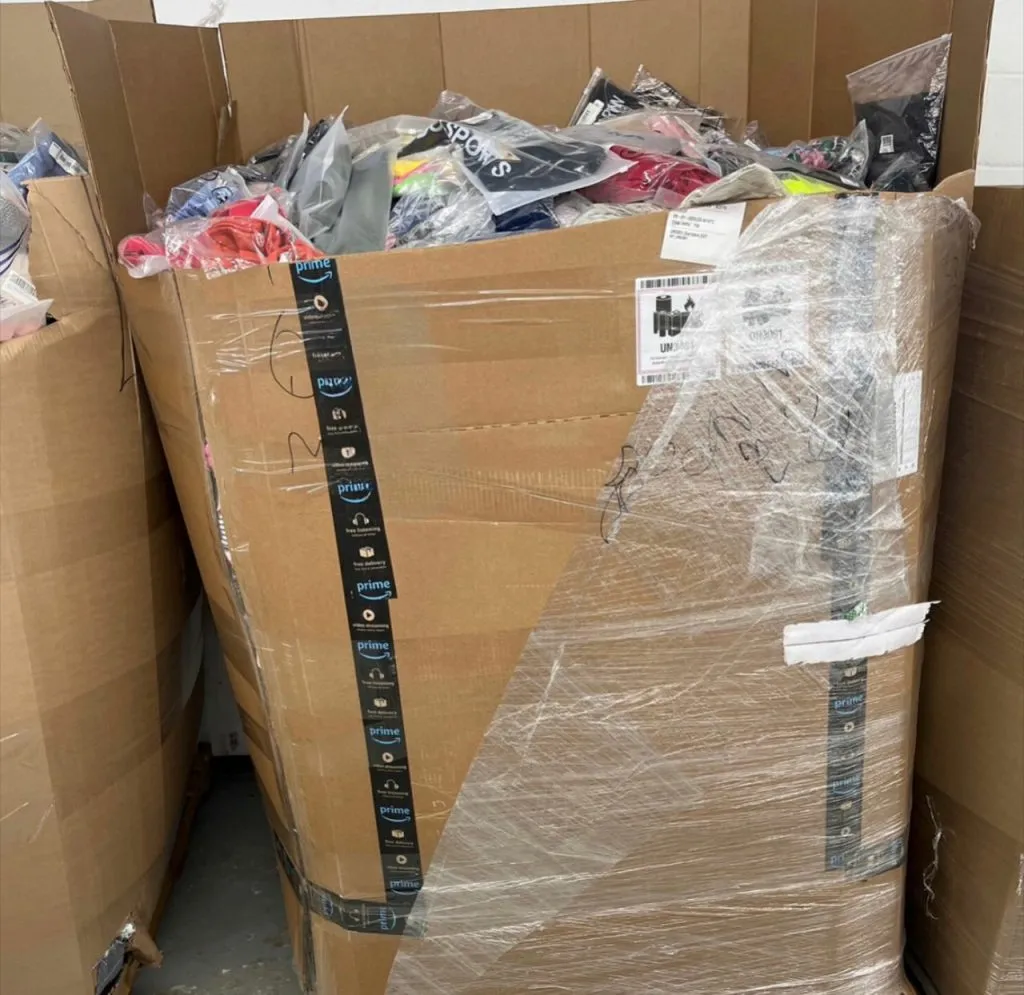
An “Amazon return pallet” is almost never a pallet packed by Amazon for you, and it is never a promise that every item is a pristine, unused Amazon gadget. In reseller slang, the phrase usually means a mixed lot of customer returns that came out of a large online retailer’s returns stream — often untested, often incomplete, and always sold as-is. This guide explains what that actually looks like, what work to plan for, and how to read a listing before you spend the money. For a comparison of returns against shelf pulls and overstock, see customer returns vs shelf pulls vs overstock.
What people mean by “Amazon return pallets”
Large online retailers take back a huge volume of merchandise. Some items were never opened. Some were tried once and sent back. Some are missing a cable, a remote, a lid or a pair of shoes. Some have a real fault. Retailers generally cannot afford to inspect, restock and resell every unit through the original storefront, so they (or the liquidation partners who handle the overflow) consolidate returns by category or by building and sell them in bulk.
When buyers say “Amazon return pallet,” they usually mean that kind of lot: general merchandise, clothing, electronics, home goods or mixed categories from an online returns stream. The carton may still carry the retailer’s packing tape. The goods vary from pallet to pallet, even inside the same program. Think of it as a slice of someone else’s returns department, not a curated box of bestsellers.
We keep a shopping page for these lots at Amazon return pallets for sale, and the current category is Amazon liquidation pallets. This article is the expectation-setting guide that sits behind those listings.
We are not Amazon
Liquidation Pallet Co is an independent Miami wholesaler. We are not affiliated with, endorsed by, sponsored by, or an authorized retailer of Amazon or of the brands that appear in a lot. Brand names and phrases such as “Amazon returns” describe the type of goods and the returns stream, not a guarantee that every item is from that retailer or brand, and they do not give you authorized-dealer status when you resell. If you list items online, describe them accurately: used or open-box when that is what they are, untested when you have not tested them, and without implying an official relationship with the original retailer.
How these lots are typically built
Online-retailer return pallets are usually packed in one of a few formats:
- Standard pallets of boxed general merchandise, shrink-wrapped on a 48-by-40-inch footprint.
- Gaylords or bulk bins — large cardboard containers on palettes, often used for clothing, smaller items, or mixed “mediums.”
- Smaller mystery lots — a lower-cost way to see what a source looks like before you buy a full pallet. See our mystery boxes.
- Truckloads — a full trailer of returns or mixed loads, for buyers who already have space and a sales channel that can absorb volume. See liquidation truckloads.
Some loads are sorted by category (clothing, electronics, home). Some are left mixed. Some come with a manifest; many do not. The packing style and the sort level should be in the listing. If they are not, ask before you buy.
What’s usually inside — and what is not promised
A typical online-retailer returns pallet can include household goods, small appliances, kitchenware, toys, décor, clothing, shoes, consumer electronics, personal care items, or a mix of all of those. The honest answer to “what’s in it?” is that contents vary by lot. Even a manifested pallet can differ slightly from the list, and an unmanifested pallet is bought on the category and the condition description alone.
What you should not expect:
- A pallet of only high-demand branded electronics, unless the listing clearly describes that kind of lot.
- Every item to be new, sealed and complete.
- Every item to work. Untested returns have not been checked.
- The original retailer’s customer-return window, warranty, or packaging presentation to travel with the goods.
You should expect a mix: some easy sellers, some units that need a clean, a missing part or a test, and some that will be donated, recycled or thrown away. Build that leftover into your math before you fall in love with the pallet price.
Condition: untested, as-is, mixed
Most online-retailer return lots are sold as untested customer returns, in used or mixed condition, unless a listing clearly says otherwise. “Untested” means nobody has verified that the item powers on, includes its accessories, or matches the box art. “As-is” means you are buying the lot in the condition it is in when it leaves our warehouse, not a graded set of individual products. At Liquidation Pallet Co, every lot is sold as-is. Read the description and our refund and return policy before you order. We review freight damage, shortages and wrong lots reported within 48 hours with photos. We do not take change-of-mind returns because the mix was different from what you hoped.
Manifested vs unmanifested returns
A manifest is a list of items, usually with quantities, descriptions and an estimated original retail value. On a returns pallet, a manifest lets you research comparable sold listings and estimate work: how many items look like they need testing, which categories you already know how to sell, and whether the retail-value total is being used as decoration or as a real planning tool. Manifests are not always 100% accurate, and the retail figure is not what you will sell the goods for.
Unmanifested returns are cheaper per unit, on average, because you are taking more of the sort-and-discover work. They suit bin stores and high-volume sellers who can price mixed goods quickly. New buyers usually do better with a manifested or tightly category-specific load for the first purchase. The same advice is in our liquidation pallet buyer’s guide; it applies even more to online returns, because the condition spread is wider than on overstock.
The work you should plan for
The purchase price is only the start. Plan time and space to sort obvious sellers from items that need a test or a clean, incomplete units, and unsellable leftovers. Anything with a plug, a battery, a motor or a heating element should be tested before you sell it as working — do not assume a boxed appliance is complete or safe. Online returns often come back without a charger, lid, remote or second shoe; decide in advance whether you will part them out, bundle, or discard. Warehouse dust and leftover shipping labels are normal; a clean item with an honest description sells faster than a dirty one with a hopeful title. Before you resell children’s products, anything with a lithium battery, or recalled goods, check the U.S. Consumer Product Safety Commission recall list. Selling a recalled product is illegal in the United States, and “I bought it on a pallet” is not a defense. If you do not have a table, a testing outlet, a few days of calendar time and a plan for disposal, start smaller or choose a cleaner overstock lot instead.
Are they worth the money?
They can be, for the right seller. The price per item is often lower than on shelf pulls or overstock because you are taking on the testing and sorting. That only works if your channel can absorb mixed condition: a bin store, a flea market, online listings that already handle used and open-box goods, or a repair workflow. They are a poor fit if you need every unit to be photo-ready and complete on day one, or if your only plan is to list “brand new sealed” items at a premium. For current price ranges and landed-cost math, see how much a liquidation pallet costs. In our November 2026 catalog, many single online-retailer return pallets were listed in the low-to-mid hundreds of dollars, with smaller mystery lots lower and truckloads much higher. Those figures change as inventory turns; always check the live listing.
How to read one of our listings
Before you buy, confirm the category and pack type (pallet, gaylord, small lot or truckload); the condition language and any exclusions; whether a manifest is included; and the approximate item count, if one is given — treat it as an estimate of units, not of sellable units. Checkout adds a flat $150 freight charge per order to the contiguous United States, or you can schedule free pickup at our Miami location, 11440 NW 122nd St Ste 700. Alaska, Hawaii and U.S. military addresses are by quote. The United Kingdom is by custom freight quote only and is not offered at online checkout (Canada ships at the same $150 flat rate per order) — contact us first. Credit and debit cards are accepted on all orders, with no minimum. After you place your order, an invoice will be sent within a few hours from sales@liquidationpalletco.com; you pay by card from that invoice. Other methods shown at checkout remain available. Then run a conservative sell-through estimate. If the pallet only works in your math when almost everything sells at a strong price, pass. You can also start with a category you already know, such as general merchandise or clothing pallets, rather than a fully mixed mystery load.
Frequently asked questions
What is an Amazon return pallet?
In reseller language, it is a bulk lot of customer returns that came out of a large online retailer’s returns stream. It is not a pallet sold by Amazon, and the contents vary from lot to lot. Liquidation Pallet Co is an independent wholesaler and is not affiliated with Amazon.
Are Amazon return pallets tested?
Usually not. Most online-retailer return lots are sold untested and as-is. Expect a mix of ready-to-sell items, units that need work, and some that cannot be sold. Plan time to test anything electrical before you list it as working.
Will I get specific brands or items?
Only if the listing or an accurate manifest says so, and even then a manifest is not always perfect. Brand names in a title describe the type of goods, not a promise that every piece is that brand, and they do not make us an authorized dealer.
Can I return an Amazon return pallet if I don’t like what’s inside?
No. Sales are final and lots are sold as-is. If the shipment is the wrong lot, is short, or arrives with freight damage, report it within 48 hours with photos so we can review it.
Are these pallets good for beginners?
They can be, if you start with a manifested or category-specific lot and estimate sell-through conservatively. If you need predictable, near-new goods, look at shelf pulls or overstock.
Do you ship Amazon return pallets outside Miami?
Yes. We charge $150 flat freight per order to the contiguous U.S., and free pickup is available by appointment at our Miami warehouse. The UK is by custom freight quote only and cannot be selected at online checkout; Canada ships at the same $150 flat rate per order.
If you can collect the lot in South Florida, read Amazon return pallets with free Miami pickup.